In the world of high-altitude mountaineering, a clear line separates "trekking" from "technical climbing." Mount Kilimanjaro (5,895 meters / 19,341 feet) sits firmly on the trekking side of that line. The short answer remains: No, you do not need technical climbing skills. You will not be expected to tie into a rope, perform a lead climb, rappel, or use an ice axe for self-arrest.
However, to dismiss the mountain as “just a walk in the park” would be misleading. While it lacks technical difficulty, it demands immense physical endurance, mental fortitude, and a respect for altitude. Let’s expand on what “non-technical” truly means, what you will face, and where first-time climbers often get confused.
Defining “Technical Climbing”
First, it is helpful to understand what you are not doing. Technical climbing involves using specialized equipment to ascend a surface that exceeds a 40-degree angle for sustained periods. This includes:
Rock Climbing (Class 5): Using ropes, cams, nuts, and harnesses to climb vertical rock faces.
Ice Climbing: Using ice screws, two ice tools, and front-point crampons on frozen waterfalls or steep glacial ice.
Mixed Climbing: Combining rock and ice techniques.
Glacier Travel: Roped-up travel across crevassed ice fields requiring crevasse rescue skills.
Kilimanjaro has none of this. There are no vertical rock bands to free-climb. There are no deep crevasses to bridge. You will never use a climbing harness, a belay device, or a dynamic rope.
The Reality of Kilimanjaro’s Terrain
Instead of technical climbing, you will encounter four distinct terrain types, each manageable by a fit hiker with basic instruction.
1. The Rainforest Zone (2,600m – 2,800m)
This is the start of every route (Lemosho, Machame, Marangu, Rongai). The trail is a well-trodden dirt path through giant ferns and podocarpus trees. It can be muddy and slippery after rain. No skill is required other than watching your footing. You are essentially hiking in a damp, enchanting forest.
2. The Moorland / Heath Zone (2,800m – 4,000m)
The trees disappear into giant groundsels and lobelias. The terrain becomes rocky, dusty, and arid. You will walk over volcanic scree (small, loose pebbles) and rock slabs. The trail is never scrambly (requiring hands); it is simply a steep incline. For sections like the "Barranco Wall," we need a special mention.
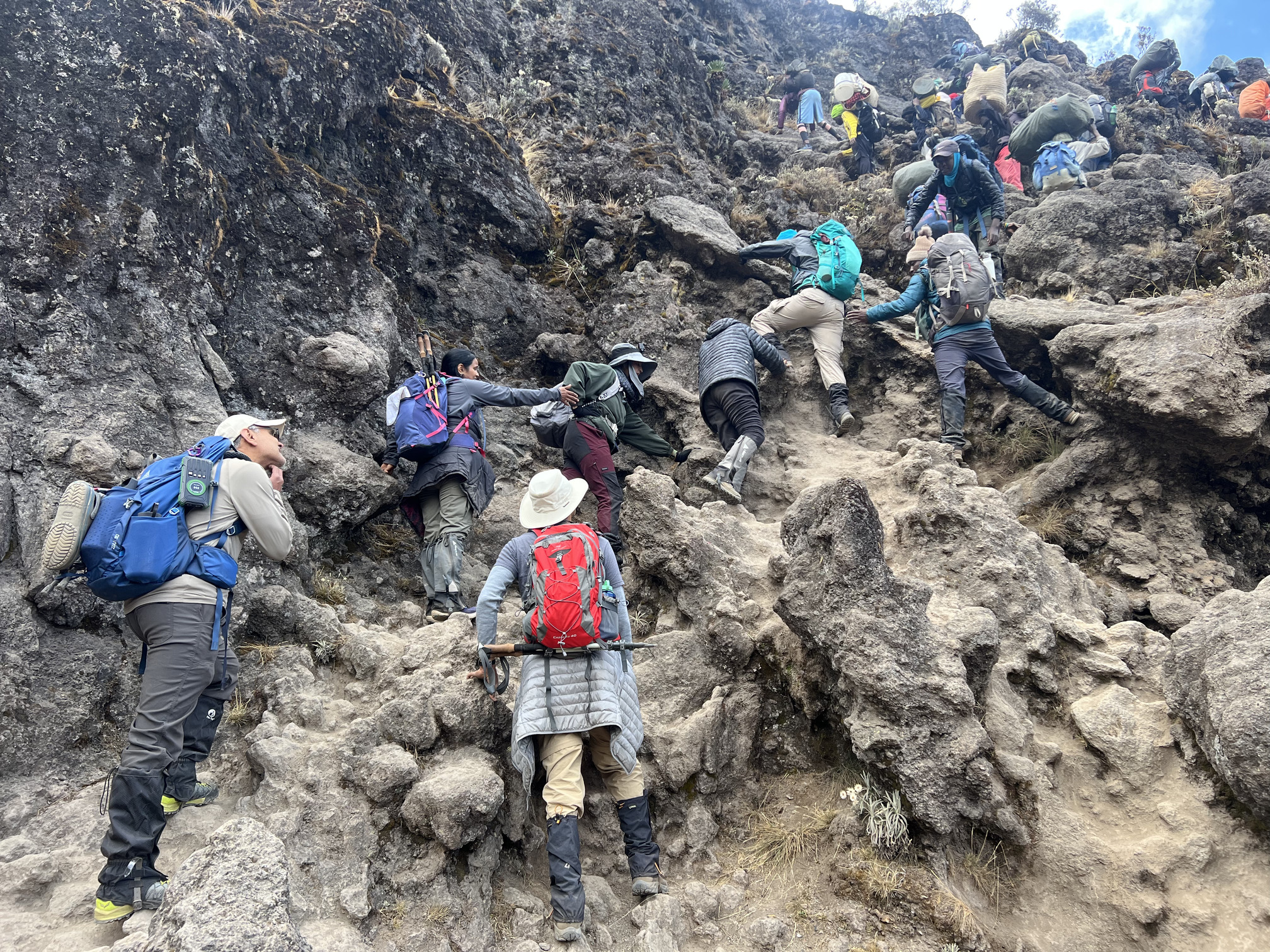
The Barranco Wall (on Machame, Lemosho, and Umbwe routes): This is the one feature novices confuse for "technical climbing." The Barranco Wall is a 250-meter-high ridge of volcanic rock. You must use your hands to pull yourself up a few sections. However, it is a scramble, not a climb. The difficulty is akin to climbing a steep ladder or a rocky staircase. There are no exposed sheer drops (unless you deliberately go off-route). Porters in sandals and flip-flops scamper up it with 20kg on their backs. If you are reasonably fit, you will ascend it in 45–90 minutes with a brief adrenaline rush, but it is not technical. No ropes, no belays.
3. The Alpine Desert (4,000m – 5,000m)
This is a barren, dusty, moonscape of scree and rocks. Walking here feels like trudging through loose gravel on a steep slope. You will use the "rest step" (a mountaineering technique to save energy) and "pressure breathing" (exhaling forcefully to expel CO2), but these are walking techniques, not climbing skills. You can learn them in 10 minutes.
4. The Arctic / Summit Zone (5,000m – 5,895m)
Summit night is where the confusion arises. You start around midnight to walk on frozen scree and glacial ice. This is the only area where crampons might be required. However, the angle of the slope on the normal routes (Marangu's Gillman’s Point or Machame’s Stella Point) is rarely more than 20–30 degrees. It is steep, but it is not a climb.
Crampons: If there is ice (usually in the final 300 meters of vertical), your guide will have you strap on simple, 10-point crampons. You will practice walking on flat ground for 60 seconds before starting. The rule is simple: "Point your toes downhill and don't cross your feet." That is the extent of your "technical training."
Snow/Ice Axe: You will not use an ice axe on standard routes. Ice axes are for self-arrest if you fall down a steep ice slope. Because the slope is low-angle and you are moving slowly in a zig-zag pattern, a fall would result in a slide that stops on its own after 20 feet, or you would hit soft snow or rocks. Only climbers attempting the very steep (and rarely climbed) Western Breach Route might need an axe. For 99% of climbers, your trekking poles are your balance aids.
What You Actually Need to Succeed (The Real Skills)
Since technical skills are irrelevant, your preparation must focus on three real pillars: Altitude Management, Physical Endurance, and Mental Resilience.
1. Altitude Management (The Real Opponent)
At 5,895m, there is 50% less oxygen than at sea level. Your body's inability to acclimatize—not a lack of climbing skill—is why 35–50% of climbers fail to reach Uhuru Peak.
Pole Pole: Swahili for "slowly, slowly." Guides enforce this relentlessly. If you feel you can walk faster, don't. Walking slowly preserves glycogen and allows your body to adjust.
Climb High, Sleep Low: Good routes (Lemosho, Northern Circuit) build in acclimatization days where you ascend to a higher point, then descend back to camp to sleep.
Symptoms of AMS: You must recognize headache, nausea, dizziness, and extreme fatigue. The "skill" here is honesty—admitting you feel unwell so your guide can get you down. There is no technical maneuver to fix altitude; only descent fixes it.
2. Cardiovascular Fitness (Not Strength)
You do not need strong biceps or a six-pack. You need a powerful engine to move your body uphill for 6–8 hours a day, and on summit night, 12–15 hours.
The Summit Night Test: You will wake at 11 PM, eat a light snack, and begin walking at midnight. You will walk for 6–8 hours in the dark, in sub-freezing temperatures, on a 30-degree slope of loose scree, at 16,000–19,000 feet. By 5 AM, you may be vomiting, have a pounding headache, and be hallucinating (seeing rocks as people). The "skill" is simply putting one foot in front of the other for 12 hours. No rope or clip will save you if your quads give out.
3. Mental Resilience & Self-Care
Pacing: Learning to walk at a pace where you can speak full sentences (the "talk test").
Hydration: Drinking 4–5 liters of water per day to combat altitude sickness. Dehydration mimics AMS.
Layering: Mastering the "vent, don't sweat" rule. On summit night, you start cold, but after 20 minutes you heat up. If you sweat, your clothes freeze. You must constantly unzip and zip jackets.
What About Extreme Routes? (The One Exception)
While the seven main routes are non-technical, there is one route that enters the technical realm: The Western Breach Route.
This route ascends a loose, 400-meter-high volcanic gully that requires scrambling over unstable rocks the size of refrigerators. Rockfalls are common. In 2006, a rockfall killed three climbers on this route. Consequently, most tour operators have abandoned it. If a company offers the Western Breach, they may require helmets and a rope for safety on exposed sections—but this is still low-angle scrambling, not vertical climbing. For 2024/2025, the Western Breach is rarely used. Stick to Lemosho, Machame, or Northern Circuit.
A Comparison to Other Mountains
To put "non-technical" in perspective, compare Kilimanjaro to other peaks:
Mountain | Height | Technical Grade | Required Skills |
|---|---|---|---|
Kilimanjaro | 5,895m | Grade 1 (Walking) | Endurance, hiking |
Mount Kenya (Nelion) | 5,199m | Grade 4+ (Rock) | Rock climbing, ropes, protection |
Mount Rainier (DC Route) | 4,392m | Grade 2-3 (Glacier) | Crampons, ice axe, roped glacier travel, crevasse rescue |
Aconcagua (Normal) | 6,961m | Grade 1-2 (Walking) | Extreme endurance, basic crampon use (similar to Kili, harder weather) |
Denali (West Buttress) | 6,190m | Grade 2-3 (Glacier) | Advanced glacier travel, winter camping, rope teams, sled hauling |
As you can see, Kilimanjaro is grouped with "walking" peaks, not "climbing" peaks.
What Equipment You WILL Need (No Climbing Gear)
You will need high-quality trekking gear, but nothing technical in the climbing sense.
Trekking Poles: Absolutely essential for scree and downhill. They save your knees.
Mountaineering Boots (Rental): Not rock climbing shoes. You need insulated, waterproof boots that accept crampons for summit night.
Crampons (Rental): Simple steel 10-point strap-on crampons. You will be shown how to click them onto your boots once.
Layers: Base layer (merino wool), mid-layer (fleece or Primaloft), outer shell (Gore-Tex), and a massive down parka for summit night.
Headlamp: Crucial for the 7-hour night hike to the summit.
You will not buy: climbing harness, dynamic rope, carabiners, cams, nuts, ice screws, ice tools, chalk bag, or belay device.
Final Verdict: Can a Complete Novice Do It?
Yes—provided they train for endurance, not strength. Tens of thousands of people with zero climbing experience reach Uhuru Peak every year. They are accountants, teachers, and retirees. They have never worn a harness or held an ice axe. They spent 6 months prior to the climb doing weekend hikes of 5–7 hours with 1,000 meters of elevation gain, and they worked on their aerobic base (running, cycling, stairmaster).
The people who fail are not the ones lacking climbing skills; they are the ones who:
Fly into Kilimanjaro Airport and start the climb the next day (no rest days for jet lag).
Only train on a treadmill at 0% incline.
Suffer from Acute Mountain Sickness (AMS) and refuse to descend.
Carry a 15kg backpack (porters carry your main bag; you carry a 3-5kg daypack).
Conclusion: Book the climb, train your legs, practice hiking with a pack, and learn how to layer clothing. Leave the ropes, ice axes, and climbing shoes at home. You are going on the world’s highest hike, not a technical mountaineering expedition.