Accommodation and Toilets on the Mountain: Where You’ll Sleep and How to Stay Clean
One of the most common questions we hear before a climb is: “What are the sleeping and toilet facilities like?” The honest answer: basic, functional, and very different from a hotel. But with the right preparation and expectations, you’ll be comfortable, safe, and even grateful for the simplicity. Let’s break down exactly what to expect, route by route, and how to handle hygiene at 4,000 meters.
There Are No Hotels or Lodges on the Mountain
Let’s be clear from the start: there are no hotels, lodges, or permanent buildings with room service on Kilimanjaro or Mount Meru. No heated rooms. No mini-bar. No Wi-Fi (except very occasionally and unreliably at a few ranger posts). You are in a high-altitude wilderness. Your accommodation will be either a mountain hut (on the Marangu route and Mount Meru) or a high-quality trekking tent (on all other routes: Machame, Lemosho, Rongai, Shira, Umbwe, and the Northern Circuit).
The difference between these two options is significant, and choosing the right route for your comfort level is key.
Marangu Route & Mount Meru: Hut Accommodation
The Marangu route is often called the “Coca-Cola route” because it’s the only one with hut sleeping. Mount Meru (the training climb for many before Kilimanjaro) also uses huts. Here’s the reality:
Sleeping arrangements: You will sleep in shared rooms with double-decker bunk beds. Rooms typically hold 4 to 8 people, sometimes more at busy camps like Mandara and Horombo. You will not get a private room unless the camp is nearly empty (rare). Expect to share with other climbers from different groups – some snoring, some waking early, some using headlamps at midnight. Bring earplugs and an eye mask.
Beds: Each bunk has a thin foam mattress. That’s it. You must bring your own sleeping bag (rated to at least -10°C / 14°F, or -20°C / -4°F for summit nights) and a sleeping bag liner (silk or fleece adds warmth and hygiene). Some trekkers also bring a lightweight inflatable sleeping pad to put on top of the mattress for extra cushioning.
Dining: Breakfast, lunch, and dinner will be served at mess rooms available in every camp on Marangu and Mount Meru. These are separate wooden buildings with long tables and benches. Meals are cooked by our kitchen crew and served hot. You eat with your group – it’s a social, warm experience. However, mess rooms are not heated beyond body heat and a few candles. Wear your fleece or down jacket inside.
Electricity in huts: All rooms are installed with a solar system – usually a single LED light bulb and perhaps one or two low-voltage USB ports. However, the power may not be sufficient for charging your cell phones. Solar panels degrade at altitude, batteries drain faster in cold, and many climbers are fighting for the same two ports. Do not rely on hut electricity. Bring your own high-capacity power bank (20,000 mAh or more) and keep your phone in airplane mode + low-power mode.
Toilets on Marangu & Mount Meru: Both routes have flush toilets – except at the base camp. Wait, flush toilets on a mountain? Yes. At Mandara Hut (2,700m) and Horombo Hut (3,720m), there are western-style squat or seated flush toilets fed by rainwater tanks. However, at Kibo Hut (4,703m) – the final camp before summit night – there are no flush toilets. Only basic pit latrines (drop toilets). Also, flush toilets can freeze in cold weather. Always carry your own toilet paper and hand sanitizer, because the huts do not supply them.
All Other Routes: Tent Camping
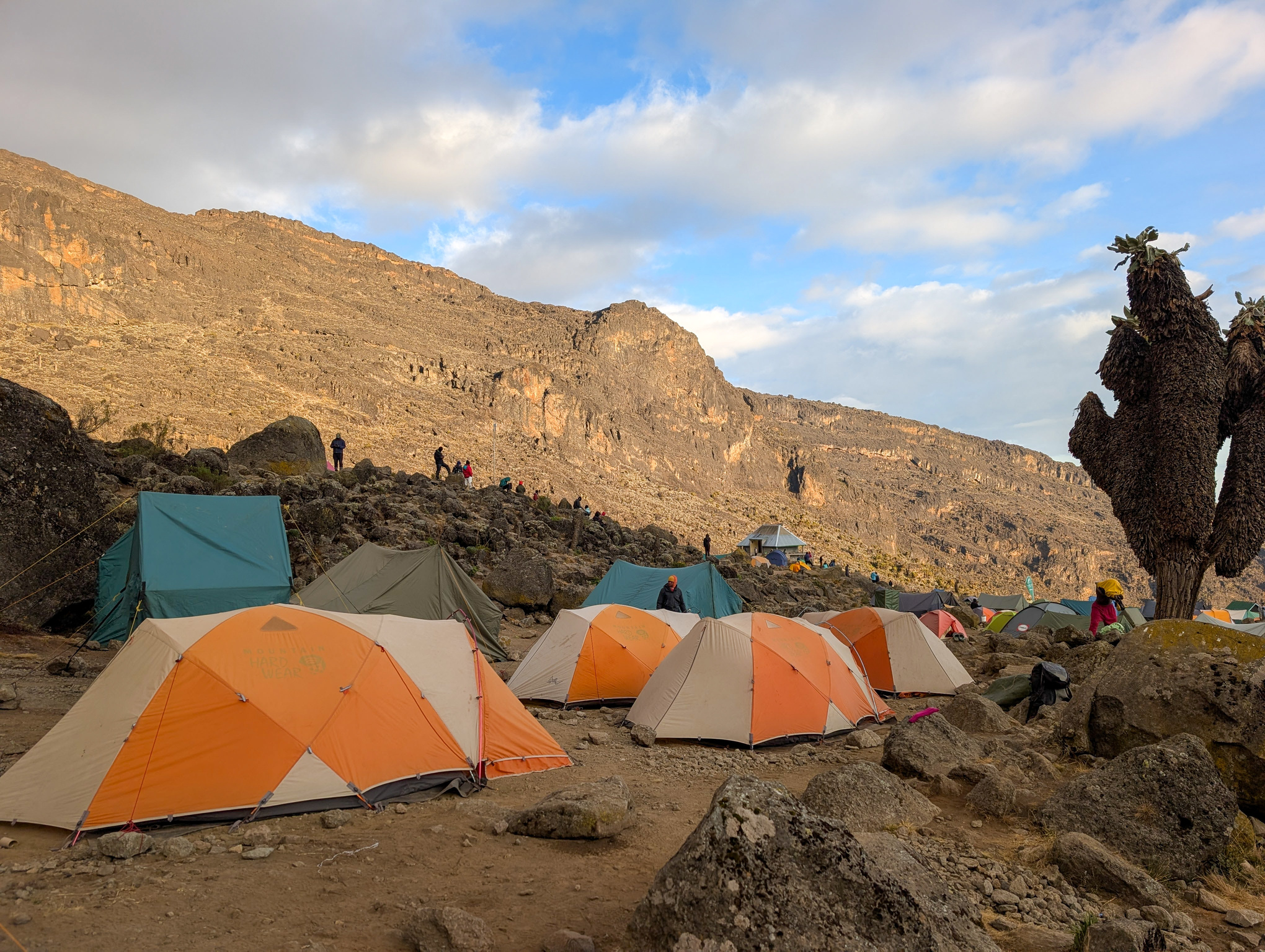
If you choose Machame, Lemosho, Rongai, Shira, Umbwe, or the Northern Circuit, you will be camping. This is the classic “wilderness” Kilimanjaro experience – more scenic, less crowded (except Machame), and more flexible. But it requires good gear and organization.
Porters are always fast. They are the unsung heroes of Kilimanjaro. After you leave camp in the morning, porters pack everything, pass you on the trail (often at a jog while carrying 20 kg on their heads), and get to the next camp earlier – sometimes 1-2 hours before you. By the time you arrive, tired and thirsty, your tent is already up, your sleeping pad is inside, and a bowl of warm washing water is waiting. Respect them. Tip them well.
Camp setup: Every group has camping managers who make sure all tents are well-pitched. They check guy lines, stakes, and ground sheets. Tents are positioned to avoid sloping ground, large rocks, and prevailing wind. We use new quality mountain tents for sleeping – usually 3-season or 4-season dome tents with a waterproof flysheet, mesh inner for ventilation, and a sturdy floor. These are not heavy expedition tents, but they are reliable for Kilimanjaro’s weather (rain, snow, strong wind on summit night).
Sharing: Every tent is shared by two clients of the same gender unless you request a single tent (additional fee, subject to availability). Sharing has benefits: shared body heat, lighter loads for porters, and a built-in buddy to check on each other during the night. If you are a couple or close friend pair, we’ll assign you together.
Other tents: We also carry:
Quality mess tents (dining tents) with tables, chairs, and sometimes a small propane heater. You eat inside here, protected from wind and rain.
Kitchen tents – where our cooks work. You won’t enter this, but it’s where hot water, tea, and meals are prepared.
Crew tents – for guides, porters, and cooks. We treat our crew with the same quality gear we give you.
Sleeping comfort: Even with a good tent, you need a proper sleeping system. The tent floor alone is cold and hard. You must bring:
A sleeping pad (insulated, R-value of at least 3.0) – inflatable or closed-cell foam.
A sleeping bag (comfort rating -10°C to -20°C / 14°F to -4°F). Down is lighter and packs smaller; synthetic works when wet but is bulkier.
A sleeping bag liner – adds 5-10°C of warmth and keeps your bag clean.
Pro tip: On summit night, bring your sleeping bag’s stuff sack and use it as a pillow. Or stuff a fleece jacket inside.
Toilets on the Mountain: Public and Private Options
No matter the route, toilets are available at all camps in the mountains. However, “available” does not mean “pleasant.” Let’s be honest.
Public toilets (pit latrines): These are permanent or semi-permanent structures – usually a wooden or metal hut over a deep hole in the ground. They have a hole (sometimes with a plastic seat), a door (often with a broken latch), and a very strong smell (ammonia from urine and feces). There is no flush. No toilet paper. No handwashing station (except a communal 20-liter jerry can with a spigot – if it’s not frozen). At busy camps (e.g., Barranco Camp on Machame route), lines can form in the morning.
How to use public toilets safely and respectfully:
Bring your own headlamp – most have no light inside.
Bring your own toilet paper in a ziplock bag – and pack out used paper in a separate ziplock (do not drop it down the hole, as it fills the pit faster and porters have to dig it out).
Use hand sanitizer before and after.
Do not leave trash or hygiene products inside.
If the door has no lock, ask a friend or guide to stand watch outside.
Private toilet option: In case you don’t want to use public toilets, you can request a private toilet from us. This is a game-changer for many climbers, especially those who are anxious about hygiene, have digestive issues, or simply want dignity at 4,000 meters.
What is a private toilet? It’s a compact, lightweight portable camping toilet – essentially a sturdy plastic seat with a sealable waste bucket. Our porters carry it separately. At each camp, they set it up inside a small privacy tent (a pop-up changing tent) a short walk from your sleeping tent. Inside: the toilet seat over the bucket, a roll of toilet paper, hand sanitizer, and sometimes a small bag for used paper. After each use, you add a scoop of a special gel powder or sawdust (provided) that solidifies waste and neutralizes odor. At the end of the trek, our crew carries the sealed bucket down and disposes of it properly – never left on the mountain.
Cost and booking: Private toilets are available for an additional fee (typically $100-200 per group for the whole trek, depending on route length). You must request this before your trek – we cannot magically produce one at camp. If you are a solo climber, you can pay for a private toilet just for yourself. If you are in a group, the cost can be shared.
Why we recommend private toilets:
You avoid long lines and cold walks at night.
You have complete control over cleanliness.
No risk of contracting stomach bugs from shared surfaces.
Much easier for women (especially during menstruation – you can pack out used products discreetly in a ziplock).
No freezing your bare skin on a frozen plastic seat at -10°C.
The only downside? You still have to walk from your tent to the privacy tent. But that’s a small price for dignity.
Final Tips for Accommodation and Toilets
Pee bottle (for summit night only): Many experienced trekkers bring a wide-mouth, clearly labeled plastic bottle (e.g., Nalgene) to use as a urine bottle on summit night. The wind on summit night can be so severe that stepping out of your tent is dangerous and miserably cold. Do this only if you are absolutely sure you can use it without spilling. Mark it with duct tape – never confuse it with your drinking bottle. Empty it into the toilet pit in the morning.
Wet wipes vs. showers: There are no showers on the mountain. Some camps have cold water taps, but bathing in freezing weather is a bad idea (you’ll lose core heat). Use biodegradable wet wipes for a “whore’s bath” (face, armpits, groin). Pack out all wipes – they do not decompose at altitude.
Menstruation: Plan ahead. Bring a ziplock for used pads/tampons and pack them out. Do not bury them. A private toilet makes this much easier.
Altitude and urination: At altitude, your body produces more urine (a natural response to altitude – don’t be alarmed). You may need to get up 1-3 times per night. Keep your headlamp and boots next to your sleeping bag. Practice getting in and out of your tent quickly.
Final Word: Comfort Is Relative
On Kilimanjaro, comfort is not about Egyptian cotton sheets or hot showers. It is about warmth, dryness, and safety. A well-pitched tent, a dry sleeping bag, and a clean (or private) toilet are luxuries. When you reach the summit and watch the sunrise over the African plains, you will not remember the cold walk to the latrine. You will remember the mountain. But good preparation – including honest knowledge of accommodation and toilets – is what gets you there with your sanity and health intact.
Pack your earplugs. Bring your headlamp. And if you can afford it, book the private toilet. Your future self will thank you.