The Great Wildebeest Migration: Earth’s Greatest Wildlife Show on Earth
Every year, 2 million wildebeest, 200,000 zebras, and hundreds of thousands of gazelles complete a 1,000 km clockwise loop across Tanzania and Kenya. Nine months of this epic journey happen in Tanzania—making it the best country to witness the full drama. it encompasses indigenous reservations and protected wildlife zones like Serengeti National Park, the Ngorongoro Conservation Area, and, on the Kenyan side, the Maasai Mara Reserve. Most of the Great Wildebeest Migration occurs within Tanzania's Serengeti National Park.
This ecosystem covers about 40,000 square kilometers (approximately 15,500 square miles) and is home to several million animals, including wildebeest, Thomson's gazelles, zebras, buffalos, giraffes, elephants, hippos, lions, leopards, cheetahs, hyenas, and many others. This rich diversity is due to a variety of habitats, from lakes, rivers, and swamps to grasslands and forests.
The ecosystem is a living model of the complex interactions between wildlife and their environment, showcasing the life cycle in all its grandeur and harshness. Drought forces mammals to leave their habitats, storm fronts guide them toward fresh grass and water, and the lush plains provide ideal conditions for raising newborn calves. However, these vulnerable young also become prey for predators and scavengers.
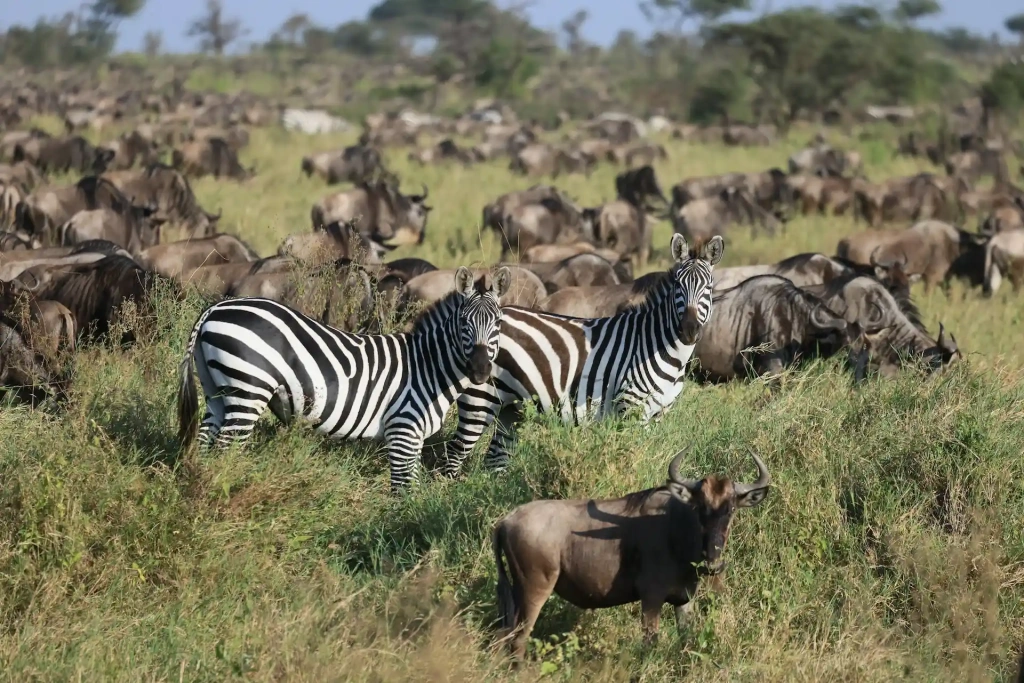
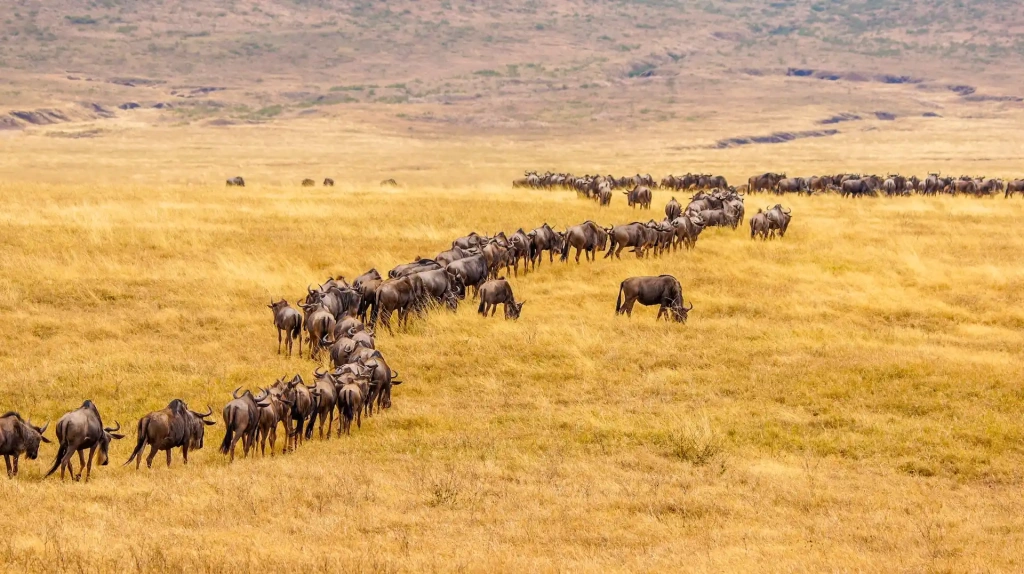
Wildebeest and zebras during the Great Migration
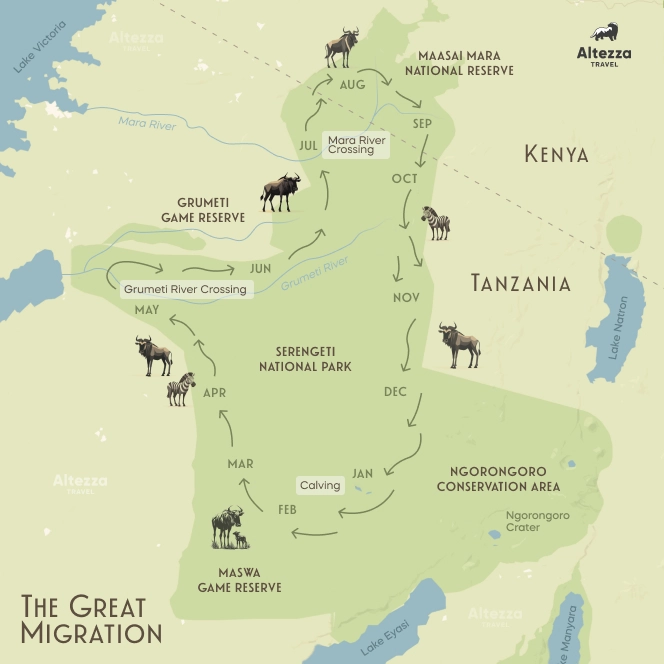
UNESCO calls the Great Migration one of the "most impressive natural events" on the planet, visible even from space. The scale is awe-inspiring: about two million wildebeest and hundreds of thousands of gazelles and zebras gather into herds and traverse the African plains, covering a total distance of 800 to 1,000 kilometers (500 to 620 miles). This grand voyage has neither a beginning nor an end, only birth and death. Following this logic, we'll outline the migration route.
Many sources claim that the mammals of the Great Migration move as one massive herd numbering over two million animals. In reality, they split into groups at different stages of the migration, stretching over tens of miles. During a safari tour, the highest concentrations of animals can be observed in the Ngorongoro Conservation Area, along the route to the Western Corridor of the Serengeti, and during the crossing of the Mara River.
The Great Migration Calendar: When to Go Where
The Migration follows a fluid, rain-driven circuit. While unpredictable, here’s the guide based on historical patterns and expert forecasts:
December–March: Calving Season (Southern Serengeti/Ndutu)
· Where: Ndutu Plains (northwestern Ngorongoro Conservation Area) and southern Serengeti.
· What to See: Synchronized births of ~8,000 calves daily (January–February), overwhelming predators like lions, cheetahs, and hyenas. Tender maternal moments and newborn energy.
· Highlights: Golden grasslands, storm clouds, and intimate predator chases.
· Crowds: Less busy than peak season; ideal for photography.
April–June: Western Corridor & Grumeti River Crossings
· Where: Western Serengeti and Grumeti River.
· What to See: Herds moving northwest, facing dramatic Grumeti River crossings with Nile crocodiles. Resident leopards and lions in woodland habitats.
· Highlights: Quieter, diverse landscapes; excellent game viewing.
· Crowds: Moderate; shoulder season value.
July–October: Mara River Crossings (Northern Serengeti)
· Where: Northern Serengeti and Mara River.
· What to See: Explosive river crossings with massive crocodiles and strong currents. Herds concentrate, creating predator feasts (lions, cheetahs).
· Highlights: Iconic drama; golden-hour photography.
· Crowds: Busy; book early for mobile camps.
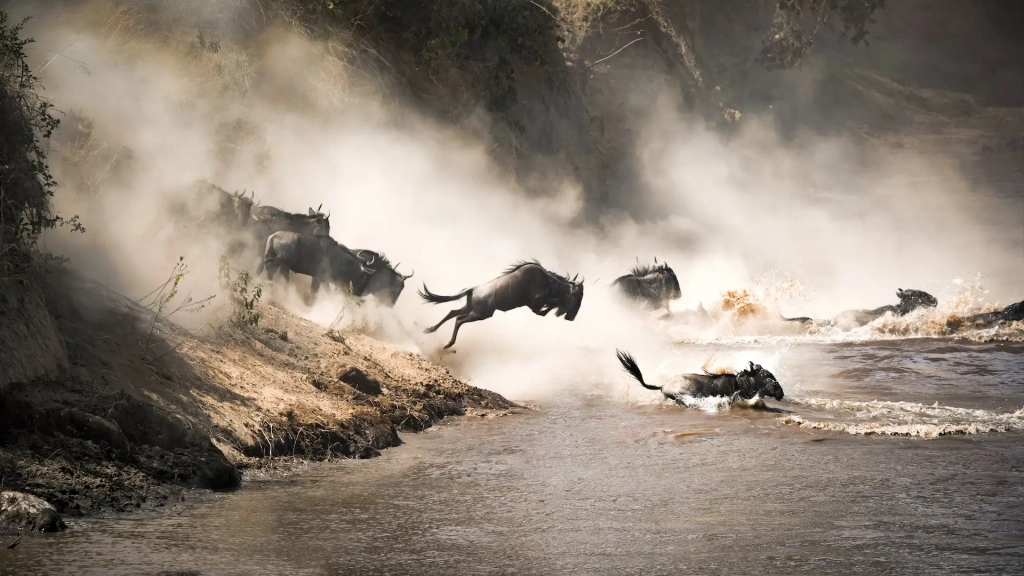
Crossing the Mara River is the most dramatic and iconic stage of the Serengeti Migration.
November: Short Rains and Southern Return
· Where: Southern Serengeti/Ndutu.
· What to See: Herds fragmenting southward as rains green the plains. Transitional sightings with resident wildlife.
· Highlights: Shoulder-season deals; dramatic storm lighting.
· Crowds: Low; great for value.
Crossing the Mara River is the most dramatic and iconic stage of the Serengeti Migration.
What is the best time to see the Great Migration?
The best time to witness the Great Wildebeest Migration depends on the kind of experience you're looking for. The most iconic and dramatic moments are in late July through early September when the herds cross the Mara River into Kenya, or during January and February in Ndutu, when the calving season unfolds on the lush plains. These periods showcase some of nature's most breathtaking spectacles but are also the busiest times. Around 90% of visitors choose these months. So, while you'll undoubtedly see the migration, you'll also encounter many vehicles. We will do our best to provide a more private experience, but complete solitude is nearly impossible to guarantee.
For a quieter experience, consider visiting the Grumeti region in May or June, when the herds move through the Western Corridor. While May may bring some rain, this time offers far fewer vehicles, making it a great option for those seeking relative privacy on their Great Migration safari in the Serengeti.
The Great Wildebeest Migration Map
Serengeti Wildebeest Migration under threat
Biology professor T. Michael Anderson of Wake Forest University likened the Serengeti-Mara ecosystem to a time machine. It gives us a glimpse of the Earth’s lost grazing ecosystems. Similar landscapes in the Americas, Australia, and Eurasia once teemed with roaming megafauna but have since disappeared.
Africa risks joining this list. Human expansion poses a far greater danger to animals than thousands of predators ever could. This includes the growth of indigenous populations and their farming lands on the outskirts of protected zones. Pastures for livestock are fenced off, and roads are constructed between settlements. This disrupts the migration paths of wild animals and deprives them of access to food and water sources. As a result of such drastic interference, one of the continent's largest wildebeest migrations was destroyed in Botswana. During severe droughts from 1979 to 1985, hundreds of thousands of animals died, unable to reach the Boteti River.
In 2017, a group of scientists led by Associate Professor Mette Løvschal from Aarhus University in Denmark found that in recent years, the number of artificial barriers for animals in the Greater Mara region (Kenya) increased by 20%. This figure continues to rise.
Disruption of historical migration routes threatens the entire ecosystem's existence
Two years later, in 2019, an international team of scientists highlighted the problem across the Serengeti-Mara. Human and livestock growth in bordering regions rapidly shrinks the available migration space, risking the cycle’s collapse.
But that's not all. A recent study led by biologists from the University of Copenhagen showed that disrupting migration routes negatively affects the genetics of wildebeest. In the long term, this could lead to reduced fertility and adaptability to external changes, such as climate shifts. That might threaten the survival of the species as a whole.
Scientists agree that the point of no return has not been reached yet. However, conservation efforts are urgently needed. New strategies are required to manage the Serengeti-Mara borderlands, potentially involving indigenous communities in conservation efforts. Without intervention, the Great Migration may soon become history.
Where to Stay for the Great Migration
Kilimanjaro Explore Travel’s mobile camps follow the herds for optimal viewing:
· Olakira Migration Camp: Relocates seasonally—Ndutu (Dec–Mar) for calving, northern Serengeti (Jun–Oct) for crossings. Intimate (12–20 guests), eco-friendly.
· Ubuntu Migration Camp: Lightweight tents relocate for exclusive access; focuses on Grumeti and Mara.
· Dunia Camp: Central Serengeti base for western migration (Apr–Jun); year-round resident wildlife.
· Namiri Plains: Eastern Serengeti for cheetahs; ideal November returns.
Tip: Mobile camps (12–20 guests) avoid large-lodge crowds (100+), offering flexibility and immersion.
Avoiding the Crowds: When & How
· Shoulder Seasons: Early July/late October for northern crossings; early June for Grumeti; early March for calving (pre-Easter).
· Mobile Camps: Smaller than permanent lodges; follow herds to quieter spots.
· Expert Guides: Kilisherpas’ guides know secondary crossings and alternative routes for intimate views.
· Early Mornings: Golden hour (dawn) drives spot action before crowds arrive.
Tip: Book 6–12 months ahead for July–October; shoulder seasons offer 20–30% discounts.
How Long Should You Stay?
· Minimum: 4–7 nights for focused migration viewing, accounting for unpredictable movements.
· Ideal: 7–10 nights for multiple regions (e.g., Ndutu calving + northern crossings).
· Multi-Region: 2–3 nights per area (south, west, north) for diverse experiences.
· Kilisherpas Recommendation: 5–7 days Serengeti + 2–3 days Ngorongoro for a complete migration safari.
What to Pack for a Great Migration Safari
· Clothing: Neutral tones (khaki, olive) for blending in; layered for mornings/evenings (lightweight shirts, fleece, windbreaker).
· Photography: Telephoto lens (400–600mm), wide-angle, waterproof bags, extra batteries.
· Essentials: Binoculars, DEET repellent, SPF 50+ sunscreen, wide-brimmed hat, comfortable walking shoes.
· Other: Insect net, lightweight rain jacket (shoulder seasons).
Tip: Pack for variable weather; early mornings can be cool (10–15°C).
Best Add-On Destinations
· Ngorongoro Crater: Big Five in a volcanic caldera; 1–2 days post-southern Serengeti.
· Zanzibar: Beach relaxation and diving; 3–5 days after northern Serengeti.
· Ruaha/Tarangire: Remote wilderness with elephants and lions; for off-season extensions.
Going on a Great Wildebeest Migration safari in Tanzania is a fantastic way to experience this stunning event in all its glory, seeing the iconic African animals up close in their natural habitat.