It has been called terrifying. It has been called exhilarating. It has been called the best hour of the entire Kilimanjaro climb.
The Barranco Wall is none of those things. And also all of them.
For thousands of climbers each year, this 300-meter rock face represents the single most memorable moment of their seven days on the mountain. For others, it is a source of anxiety that lingers from the moment they book their permits until they finally place their hands on that ancient volcanic rock.
Here is the complete truth about the Barranco Wall, written by the expert guides at Kilimanjaro Explore – the men and women who have guided beginners up this wall over a thousand times. By the time you finish reading, you will know exactly what to expect, how to prepare, and why this "scary rock face" might just become your favorite memory of Africa.
Part 1: What Actually Is the Barranco Wall?
The Basics
The Barranco Wall is a steep geological feature on Kilimanjaro's southern flank, located between Barranco Camp (3,960 meters) and Karanga Camp (4,035 meters) . It rises approximately 250 to 300 vertical meters – roughly the height of a 75-story building. But unlike a building, you won't be taking an elevator.
The wall is composed of ancient volcanic breccia – a chaotic mixture of rock fragments cemented together by lava flows millions of years ago. The result is a textured, grippy surface that provides excellent footing and handholds. This is not smooth cliff face. It is a natural staircase, albeit a very steep and irregular one.
The Geography Context
To understand the Barranco Wall, you need to understand where it sits in your Kilimanjaro journey.
The day before the wall, you have completed your "climb high, sleep low" acclimatization day. You climbed from Shira Camp (3,840m) to Lava Tower (4,630m) – the highest point you have reached so far – then descended to Barranco Camp at 3,960 meters. You slept surrounded by giant senecio plants that look like something from a Dr. Seuss illustration. Behind your tent looms the wall itself, its profile dark against the stars.
The morning you climb the wall, you are well-rested, well-fed, and approximately 48 hours away from summit night. Your body has begun adapting to altitude. Your legs are tired from three days of hiking but strong enough for what comes next.
Why Does the Wall Exist?
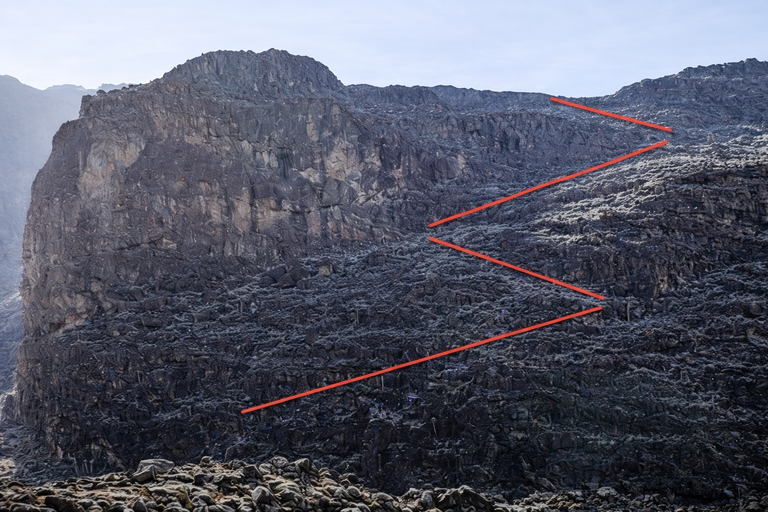
Geologically, the Barranco Wall is an erosional feature. Millennia of water and ice have carved away softer rock, leaving this resistant spine exposed. Climbers don't so much "climb the wall" as they follow a natural ramp that traverses diagonally across its face.
The key insight: You are not climbing straight up. The trail switchbacks, traverses, and scrambles its way up at an angle. This makes the wall significantly less intimidating than it appears from camp.
Part 2: The Climb Experience – Minute by Minute
The Approach (30 minutes)
You leave Barranco Camp around 7:00 AM, after a hot breakfast of porridge, eggs, toast, and tea. The morning air is cold but the sun is rising behind you, painting the western slopes in gold.
For the first 20-30 minutes, you hike on relatively gentle terrain at the base of the wall. Your guide points upward and says, "We go there." You look up. Your stomach tightens. The wall looks impossibly steep.
This is normal. Every climber feels this.
The Lower Wall (45 minutes)
The climb begins gradually. You use your legs more than your hands at first. The trail is wide enough for one person – sometimes two. Your guide climbs directly behind or ahead of you, depending on the section.
The rock is rough and dark, worn smooth in places by thousands of boots but still grippy. You step from rock to rock, following a path that feels ancient because it is – this same route has been used by porters, guides, and climbers for over a century.
Altitude check: You are between 3,960m and 4,200m during this section. You will breathe harder than you expect. You will need to stop every 5-10 minutes to catch your breath. This is not weakness. This is altitude. Even elite athletes stop on the Barranco Wall.
The Kissing Rock (10-15 minutes)
Approximately halfway up, you reach the most famous feature on the wall: The Kissing Rock.
This is a narrow section where the trail squeezes between the rock face on one side and a sheer drop on the other. The gap is just wide enough for one person. To pass, you must turn sideways, press your body against the rock, and shuffle across.
Why "Kissing Rock"? Because you get close enough to kiss the rock. Some climbers do, for luck. Others press a hand against it and whisper a prayer.
The reality: The Kissing Rock looks far more dramatic in photographs than it feels in person. The exposure is real – there is a drop – but the footing is solid, and your guide will be positioned on the far side, ready to steady you. Thousands of climbers cross it every year without incident. Children as young as ten have crossed it. Elderly climbers in their seventies have crossed it.
The mental trick: Don't look down. Look at the rock. Look at your guide. Take one step, then another. In thirty seconds, it's over.
The Upper Wall (30-45 minutes)
Above the Kissing Rock, the wall steepens again. This section requires more consistent use of your hands. You will pull yourself up onto ledges. You will search for footholds. You will feel like a real climber.
This is also where the queue forms on busy days. During peak season (January-March, June-October), dozens of climbers ascend the wall simultaneously. At narrow sections, you wait. And wait. And wait.
The upside of waiting: You catch your breath. You take photographs. You talk to climbers from other groups. You realize that everyone – from the fit twenty-something to the nervous first-timer – is having the same experience.
The Summit of the Wall (15 minutes)
After 1.5 to 2.5 hours of climbing, you reach the top. The gradient eases. The trail widens. And then you turn around.
The view from the top of the Barranco Wall is one of the finest on Kilimanjaro.
Behind you, the wall drops away to Barranco Camp, now a tiny cluster of colored dots far below. Beyond the camp, the Shira Plateau stretches to the horizon. Ahead, Kibo Peak – your summit destination – rises massive and snow-capped. Below, Karanga Camp sits in a valley, your lunch destination.
Most climbers spend 10-15 minutes here, catching their breath, drinking water, and taking photographs. Some cry. Many hug their guides. Nearly everyone feels a surge of confidence: If I can climb that wall, I can climb anything.
Part 3: Physical Demands – What Your Body Goes Through
The Technical Reality
Let's be absolutely clear: The Barranco Wall is not technical climbing.
You do not need:
Ropes
Harnesses
Carabiners
Helmets (though some climbers wear them for peace of mind)
Previous climbing experience
You do need:
Basic balance
The ability to lift your body weight with your legs
Willingness to use your hands for balance
Trust in your feet
The wall is graded as a Class 3 scramble in mountaineering terms. That means you use your hands for balance but never for pulling your full weight. Compare this to technical rock climbing (Class 5), which requires ropes and training. The Barranco Wall is challenging but fundamentally accessible.
The Altitude Factor
Here is what makes the wall genuinely difficult: the altitude.
At 4,000 meters, the air contains approximately 60% of the oxygen available at sea level. Your heart beats faster. Your lungs work harder. Simple movements – standing up, putting on a backpack – require noticeable effort.
On the Barranco Wall, you are climbing steep terrain while breathing thin air. Every ten steps, you may need to stop. Your thighs will burn. Your breathing will be heavy. Your heart rate will climb.
This is normal. This is expected. This is not a sign that you are failing.
The Kilimanjaro Explore guides build rest stops into the ascent. You stop every 5-10 minutes, sometimes more often. You drink water. You catch your breath. You take a photograph. Then you continue.
Common Physical Challenges
Challenge | How It Feels | What to Do |
|---|---|---|
Shortness of breath | Like you just ran up stairs | Stop. Breathe deeply. Wait for your heart rate to settle. |
Leg fatigue | Burning thighs, shaky knees | Use your hands to pull. Step with your stronger leg first. |
Balance concerns | Fear of falling | Keep three points of contact (two feet, one hand). Move slowly. |
Dizziness | Lightheadedness | Sit down immediately. Tell your guide. Check for other AMS symptoms. |
Fear of heights | Racing heart, tunnel vision | Focus on the rock in front of you. Don't look down. Trust your guide. |
Part 4: Mental Preparation – Overcoming the Fear
Why the Wall Feels Scarier Than It Is
The Barranco Wall suffers from a reputation problem. Climbers see photographs of the Kissing Rock with its dramatic drop. They read forum posts calling it "terrifying" or "the hardest part of the climb." They arrive at Barranco Camp, look up at the dark silhouette against the stars, and spend a sleepless night worrying.
Here is the truth that experienced guides know: The Barranco Wall is far less intimidating than it appears from below.
From camp, the wall looks vertical. It looks exposed. It looks dangerous. But the trail does not go straight up. It traverses. It switchbacks. It finds the path of least resistance. What looks like a sheer cliff face from a distance becomes a manageable scramble up close.
Mental Strategies from Kilimanjaro Explore Guides
The "Three Steps" Rule: Don't look at the top of the wall. It's too far away. Don't look at the drop below. It's irrelevant. Look only at the next three handholds and footholds. Move three steps. Pause. Then find the next three.
The "Guide Trust" Technique: Your Kilimanjaro Explore guide has climbed the Barranco Wall hundreds of times. They know exactly where to place each foot. When fear rises, look at your guide. If they look calm, you can be calm.
The "Queue Gratitude" Reframe: When you wait on a narrow section, don't curse the crowd. Thank the crowd. Every minute you wait is a minute you breathe. A minute your heart rate drops. A minute your body acclimatizes.
The "Photograph Pause": Force yourself to take photographs every 15 minutes. This does two things: it creates a natural rest break, and it shifts your focus from fear to beauty.
What Beginners Say After Climbing the Wall
Kilimanjaro Explore has collected hundreds of post-climb debriefs. Here is what beginners actually say about the Barranco Wall:
"I was terrified the night before. I almost didn't sleep. And then we climbed it, and I kept waiting for the scary part, and it never came. It was just... fun."
— Sarah, 34, first-time climber
"The Kissing Rock looks insane in photos. But when you're there, your guide is right there, and the rock is so grippy, and you just shuffle across. It took fifteen seconds."
— Michael, 52, experienced hiker
"The hardest part wasn't the wall. It was the altitude. My legs were fine. My lungs were the problem. But we stopped every few minutes, and my guide kept saying 'pole pole,' and we made it."
— James, 28, marathon runner
"I cried at the top. Not because it was hard. Because I was proud of myself."
— Linda, 61, retired teacher
Part 5: Which Routes Include the Barranco Wall?
The Barranco Wall is a feature on the following routes:
Route | Includes Barranco Wall? | Day of Climb | Notes |
|---|---|---|---|
Machame (7-day) | Yes | Day 4 | Most common route to experience the wall |
Lemosho (8-day) | Yes | Day 5 | Same wall, better acclimatization beforehand |
Northern Circuit (9-day) | Yes | Day 6 | Least crowded approach to the wall |
Shira (7-day) | Yes | Day 4 | Similar to Machame |
Marangu (6-day) | No | N/A | Avoids the wall entirely |
Rongai (7-day) | No | N/A | Northern approach, different terrain |
For Climbers Who Fear the Wall
If the Barranco Wall genuinely terrifies you – not just nervousness but deep, paralyzing fear – you have options:
Choose Marangu Route: This route avoids the wall entirely. The trade-off is lower success rates (70-75%) and hut accommodations instead of camping.
Choose Rongai Route: The northern approach also avoids the wall. Success rates are similar to Machame (85-90%), but the scenery is less varied.
Trust the Guides: The Kilimanjaro Explore team has guided climbers with severe vertigo up the Barranco Wall. They use specific techniques: keeping the climber between two guides, setting an ultra-slow pace, and using verbal coaching for every single step.
The honest truth: Of the thousands of climbers Kilimanjaro Explore has guided up the Barranco Wall, fewer than 1% have turned back due to fear. The wall looks worse than it is. Your guides know this. Trust them.
Part 6: Practical Tips for Conquering the Wall
Gear Tips
Do wear:
Grippy hiking boots – The rock is abrasive but grippy. Broken-in boots with good tread are ideal.
Light gloves – The rock can be cold at 7 AM. Thin liner gloves or light work gloves protect your hands without reducing dexterity.
Daypack (5-8 kg maximum) – You need water, snacks, camera, and an extra layer. Nothing more. Your porter carries the heavy gear.
Don't wear:
Heavy winter gloves – You need to feel the rock.
Rain pants – Unless it's actively raining, you'll overheat.
Cotton anything – Cotton stays wet and causes chafing.
Hydration and Nutrition
Drink 0.5-1 liter during the 1.5-2.5 hour climb
Eat a substantial breakfast – porridge, eggs, toast, tea
Bring quick snacks – energy gels, chocolate, nuts, dried fruit
Avoid heavy meals – no large breakfast if you have a sensitive stomach
Photography Tips
Shoot from below – Photographs taken from the base make the wall look impossibly steep
Shoot from above – The views from the top are worth a dozen summit photos
Don't stop in narrow sections – Keep moving; take photos at designated rest spots
Hand your camera to your guide – They know the best angles and won't drop it
What to Do If You Struggle
If you freeze (stop moving due to fear):
Tell your guide immediately: "I'm stuck."
Your guide will reposition to face you and give hand-by-hand, foot-by-foot instructions.
Take three deep breaths before moving.
Remember: you can sit down. The trail is wide enough to sit.
If you experience severe shortness of breath:
Stop. Sit on a rock if possible.
Take slow, deep breaths – inhale for 4 seconds, hold for 2, exhale for 6.
Tell your guide. They will check your pulse oximeter and symptoms.
You may need to descend. This is rare, but it happens. There is no shame in it.
If a panic attack begins:
Your guide has seen this before. They will talk you through it.
Focus on a single rock in front of you. Count its cracks.
Breathe. Just breathe. The feeling will pass.
Part 7: The Barranco Wall in Context – Why It Matters
More Than Just a Rock Face
The Barranco Wall is not merely an obstacle. It is a psychological turning point on the Kilimanjaro journey.
Before the wall, you are a tourist – someone who paid money to walk up a mountain. After the wall, you are a climber – someone who has faced a genuine challenge and overcome it.
The confidence you gain on the Barranco Wall carries directly into summit night. Climbers who conquered the wall face summit night with less fear and more self-belief. This is not coincidence. This is the wall's purpose, whether the mountain designed it that way or not.
A Word on Summit Night
The Barranco Wall is often called the "hardest part" of Kilimanjaro. This is incorrect.
Summit night is harder.
Summit night happens at midnight, in temperatures well below freezing, with half the oxygen of sea level, after days of accumulated fatigue. You climb for 6-8 hours in darkness. Your body will hurt in ways you cannot imagine from sea level.
But here is why the Barranco Wall matters: if you can climb the wall, you have proof that you can do hard things at altitude. You have evidence that your body is capable. You have memories of fear overcome.
The wall is not the hardest challenge on Kilimanjaro. It is the most important confidence-builder.
Part 8: Frequently Asked Questions
Is the Barranco Wall dangerous?
No, not when climbed with proper guides and in good weather. There have been no fatal falls on the Barranco Wall in over a decade of commercial climbing. The route is well-established, the rock is grippy, and guides are positioned at every tricky section.
Can I skip the Barranco Wall?
On routes that include it (Machame, Lemosho, Northern Circuit), no. There is no alternate trail. If you cannot climb the wall, you cannot continue on those routes. This is why Marangu and Rongai exist.
What if it rains on wall day?
Your guide will assess conditions. Light rain is manageable – the rock remains grippy. Heavy rain or lightning will delay or cancel the ascent. In rare cases, climbers wait at Barranco Camp for an extra day.
Do I need gloves?
Recommended but not required. Thin gloves protect against cold rock and minor abrasions. Many climbers go bare-handed for better grip.
How fit do I need to be?
You need basic leg strength and balance. You do not need upper body strength – you use your hands for balance, not pulling. Kilimanjaro Explore has guided 70-year-olds and 10-year-olds up the wall successfully.
Can I take a backpack?
Yes, but keep it light (5-8 kg maximum). Heavy backpacks shift your center of gravity and make balance harder.
Final Thoughts: Why You Will Love the Barranco Wall
The Barranco Wall is not your enemy. It is your teacher.
It teaches you that fear and capability can coexist – that you can be terrified and still move forward. It teaches you to trust your guides, your body, and the ancient rock beneath your feet. It teaches you that the hardest things are often the most rewarding.
And when you reach the top, turn around, and see how far you have climbed – you will understand why thousands of climbers list the Barranco Wall as their favorite memory of Kilimanjaro.
Not because it was easy. Because it was worth it.
Ready to Climb? Book with Kilimanjaro Explore
The Kilimanjaro Explore team has guided thousands of beginners up the Barranco Wall and on to the summit of Uhuru Peak. Our senior guides – including Gilberto Bureta with over 100 successful summits – know every handhold, every rest spot, and every technique for guiding nervous climbers through the Kissing Rock.
Your 2026 adventure starts with a conversation. Contact our travel consultants for a personalized route recommendation, pre-climb Zoom briefing, and answers to every question you haven't thought to ask yet.
The wall is waiting. So is your summit.